 Stefano Zamblera – Xiulong
presents
Créatures mythiques animales dans les manuscrits naxis
Complete study made for Arras Congress: “Les signes d’animaux et de créatures mythiques en Orient et en Occident“
My study of texts of manuscripts, iconographies, detailed analisys of signs of animals associated to supernatural entities evinced:
·Ssù – serpent cult. Based of the veneration of the serpent-tailed and human-body spirits, a life-god entity. Propitiated for granting prosperity and fertility, closely associated to rain and water, able to provoke terrible misfortunes if got hungry with humans. In this study it’s directly related to the traditions of kLu in Tibet, Nāga
in India and Long in China
·Bird-god cult. Bird deities are powerful, strong, able to suppress the serpents-spirits and devour them. Able to spell charms, allied to Shilo the founder of Dongba tradition. In this study the bird-gods of Naxi – Dongba pantheon are associated to mythologies of Khyung–chen of Tibet and Garuda of India.
·Serpent vs. Eagle fight myth, here directly related to the mythologies of kLu versus Khyung-chen of Tibet and Naga versus Garuda of India
As emerged from manuscripts and according to Naxi tradition, I mean the central figure of Dongba Shilo not just as the founder of Dongba religion, but as directly related to the Enlightened Buddha sTompa gShen-rab of Bön tradition.
Methodology of research
According to the theme of the colloque, the methodology of study I adopted mostly consisted in the research of signs from documents, as the signs are pictographs which were made of an animal-based graphic unit, directly relate to deities. Once they’ve been found the study of the functions of signs ad of the context was the way followed: identification of readings and meanings associated to pertinent signs, alias the research of the signs’ phonetic and semantic values, the identification and the interpretation of iconographic motifs associated to the pertinent sign.
Then I studied the context, which here is meant as the study of the signs surrounding the pertinent one in an adjacent part of text (mostly the rubric containing the pertinent pictograph), as the research of eventual relationship with surrounding signs in adjacent parts of text for the identification of eventual association patterns among signs,.
Once sign was identified as pertinent, alias study of the sign and its contexts evinced that by this significant a deity was meant, then a deeper analysis I started, focused on the detailed study of the iconography represented by the sign and its variants, the reconstruction of iconologies, also with the help of cross-studies focused on related (but non necessary Naxi) cultural, iconographic and iconologic elements; this methodology permitted to the author some integrations with non Naxi – Dongba directly related documentation, as Indian, Tibetan and Chinese.
First stage of my study, which consisted in the identification of pertinent signs, was performed by the analysis of available sources which contains attestations of pictographs with an animal-based graphic unit. Nature of available sources evinced the possibility of making use of two kind of attestations: direct and indirect attestations.
- ·Direct attestations: are those performed directly from documents belonging to Naxi – Dongba pictographic tradition: manuscripts, scrolls, wall-paintings, handcrafts and sculptures. Some hundreds of documents are available online thanks to Harvard Yenching web resources, which consist in a selection from their collection of 598 manuscripts. By this web resource is possible to perform direct analysis over Dongba manuscripts, avoiding the difficulties in retrieving of documents.[1]
- ·Indirect attestations: are those made and evinced from documents which not belong to Naxi – Dongba tradition, but directly or indirectly dedicated or related to Naxi culture and Dongba, in particular dictionaries, Naxi mythology and Dongba culture dedicated studies.[2]
By this two ways of attestation, the signs I identified as pertinent, alias signs associated and identified as a deity, I then recorded in a concordances’ system, with manuscripts’ page, rubric, reading and meaning.
As introduced upper, further analysis of surrounding contexts I performed for identification of possible association of signs: sources evinced a number of not casual association, here meant as recurring pattern, with peculiar reading and meaning, pertinent inside the context of animal-deities belonging to Naxi – Dongba Pantheon.
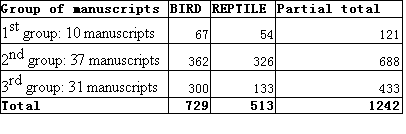
Such group of pertinent signs evinced by sources from direct and indirect attestations, on a corpus of 78 manuscripts,[3] according to contexts and to dedicated bibliography, scored 1242 attestations of signs of animals associated to 2 main groups of iconographies of deities:
◦reptile – gods iconography,
with 513 attestations
◦bird – gods iconography,
with 729 attestations
Analysis of context which the pertinent signs belong to, evinced to me a very complex pantheon of gods with many subgroups of deities, both in reptile and bird forms: reptile and bird iconographies thus here I meant as two main classes of gods, as from contexts they appear to be antagonist, while inside bird and reptile group of deities the different form of spirits are often in close interaction, share a common origin, and acts in strong influence and interaction with/against humans.
The reptile – deities iconographies was thus characterized of different and distinguished kind of supernatural entities:
· serpent-tailed, human headed with trilobate crown, associated to many readings: Ssù, Llü–mun, Ssaw–ndaw and/or mute sign
· dragon iconography, associated to the reading Lu
· serpent iconography, associated to the reading Shi-zi
The bird – deities iconographies also contains at least 3 different gods:
· iconography, associated to the reading Khyu–t’khyu
· iconography, associated to the reading Dter–gko
· iconography, associated to the reading Yu–ma
For full work please, browse the table of contents below, or the menu on the nav-abr of the header, or again on the right frame: data, concordances and statistics here quoted are completely available.[4]
This paper and all linked material here available in English language is recorded under a Creative Commons license, here published and freely shared for academic purpouse, available to every scholar dedited to Naxi People and Culture and Dongba tradition.

Créatures mythiques animales dans les manuscrits naxis by Stefano Zamblera is licensed under a Creative Commons Attribution-NonCommercial-ShareAlike 3.0 Unported License.
Based on a work at www.xiulong.it.
[1] http://nrs.harvard.edu/urn-3:FHCL:hyl00002 For a detailed description of Harvard Yenching web resource and features please, cfr.: https://www.xiulong.it/4.0/Dongba/CENSUS/bycollections/HY/introHY.php
For an exemple of Harvard Yenching manuscripts pertinent to the theme studied (the Ssù cult) and for crossing references with Joseph Rock manuscripts’ collection please, cfr:
https://www.xiulong.it/Dongba/conferences/Arras2010/Attestations/SsuCultManuscriptsCorpus.htm
[2] Particular attention was focused on Dongba pictographs dictionaries and monograph studies dedicated to Dongba religious tradition, with an eye especially focused on Joseph Rock and Chas McKhann works . In particular cfr.: Rock J., 1952, 1963, 1972; McKhann C., 1989, 2003c, 2003d
[3] Here manuscripts are grouped in 3 clusters, just for a more comfortable layout. Data are available online:
https://www.xiulong.it/Dongba/conferences/Arras2010/Attestations/AnimalGodsGeneral.htm
Table of contents
- Introduction to the script
- Iconography of reptiles deities
- Iconography of Eagle-winged deities
- Bibliography
- List of Naxi – Dongba manuscripts consulted
1 thought on “Créatures mythiques animales…: the complete preliminary paper (browse)”